
Access Livingston County Death Index
Livingston County death index records serve researchers exploring family history in the Finger Lakes region of New York. The county was formed in 1821 from Genesee and Ontario counties and named for Robert R. Livingston, chancellor of New York State. Death records here follow the local registrar model, with each town clerk filing and keeping original death records from the 1880s forward. The county seat is Geneseo, home to SUNY Geneseo. Livingston County does not have any cities that meet the population threshold for their own pages on this site, so all death index research routes through town clerks or the state.
Livingston County Death Index Overview
Livingston County Death Records Overview
Death records in Livingston County are held by town clerks. There is no single county office that stores death certificates. Each town clerk acts as a local registrar under New York State law. When someone dies in a specific town, that clerk files and keeps the record.
The Livingston County Clerk in Geneseo maintains land records, court records, and other civil filings. The county clerk does not hold death certificates or death index records. If you contact the county clerk about a death record, they will point you to the right town clerk or to the NYS DOH.
Towns in Livingston County include Avon, Caledonia, Conesus, Geneseo, Groveland, Leicester, Lima, Livonia, Mount Morris, North Dansville, Nunda, Ossian, Portage, Sparta, Springwater, West Sparta, and York. Each town clerk handles vital records for deaths in their jurisdiction.
How to Search the Death Index
Knowing where the death took place is essential. The record is filed in the town where the death happened. In Livingston County, hospital deaths may cluster in towns with medical facilities. A person who lived in a small town might have died at a hospital in a neighboring town or even in nearby Rochester (Monroe County).
If you do not know the town, use the statewide death index. The NYS Archives has free microfiche indexes that cover death records from the 1880s forward. These list name, date, place, and certificate number. You can search these in person at the archives in Albany at no cost.
The Livingston County Historian may also be able to help. County historians in New York often maintain research files and can point you toward the right town or local resources. They may know about records that are not in the standard indexes.
State Death Index Resources
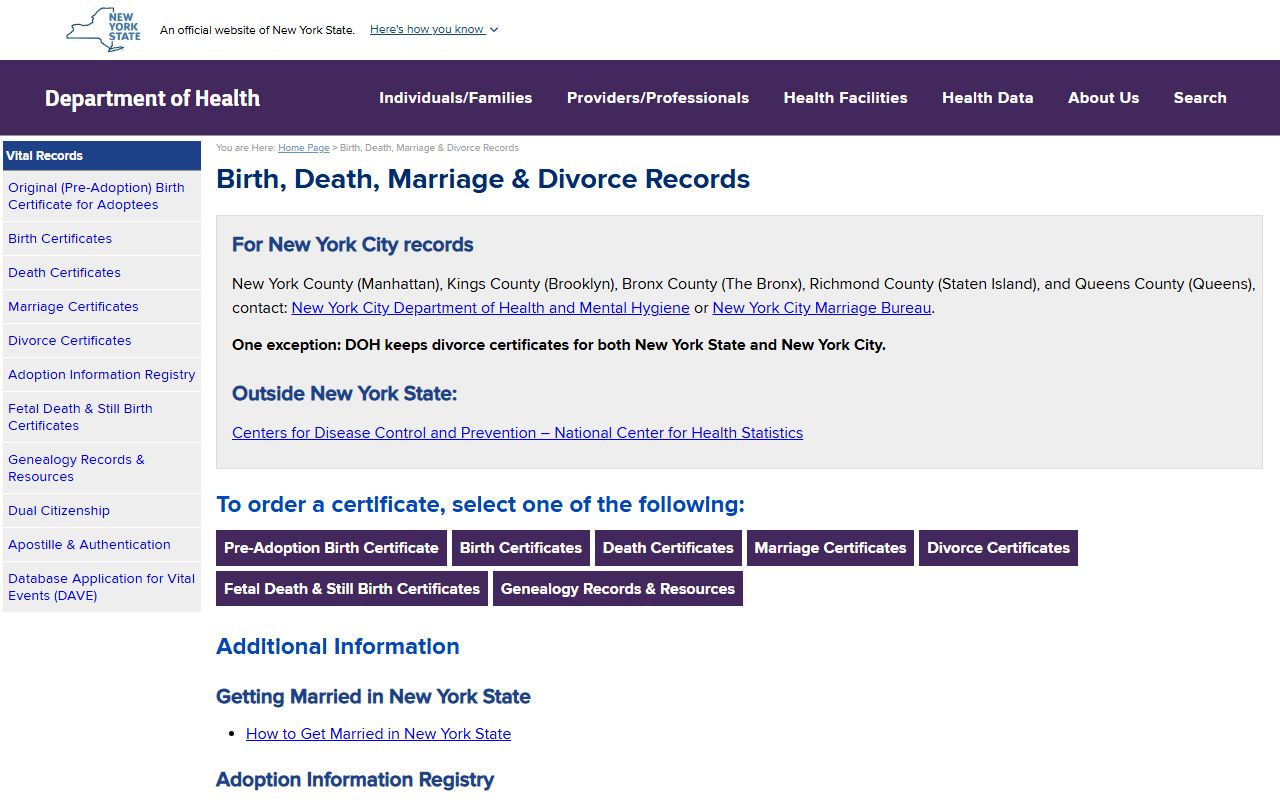
The NYS Department of Health holds copies of death records from the early 1880s for all New York counties. Death indexes become public 50 years after the date of death. You can request copies by writing to PO Box 2602, Albany, NY 12220-2602 or by calling (855) 322-1022.
Genealogy search fees start at $22 for 1 to 3 years and go up to $202 for 81 to 90 years. Knowing the exact year saves you money. Processing time is 8 months or more. This is a known bottleneck in New York vital records research.
For faster service, try the town clerk directly. Most Livingston County town clerks respond to mail requests within a few weeks if you give them enough information to find the record. Include the deceased person's name, date of death, and the town where the death occurred.
Livingston County Death Index for Genealogy
Livingston County has a rich agricultural history. Many families lived in the same area for generations, which can make genealogy research easier in some ways. Death records from the late 1800s and early 1900s often include useful details like parents' names, birthplace, and occupation.
Church records are a valuable supplement to the official death index. Many communities in Livingston County had active churches that kept their own registers of deaths, burials, and memorial services. These records sometimes include information not found on the official death certificate.
Cemetery records are another resource. The county has many cemeteries, some quite old. Local genealogical societies and the Livingston County Historical Society may have transcriptions. These can confirm death dates and provide family connections when official records are incomplete.
Under 10 NYCRR 35.4, New York governs how death records are filed and accessed. Vital records cannot be obtained through FOIL. Direct-line descendants can request records at any time with proof of relationship.
Ordering Livingston County Death Certificates
Write to the town clerk where the death took place. Your request should include the full name of the deceased, the date of death or a year range, and the place of death. Also include your name, address, relationship to the deceased, and a phone number or email so the clerk can reach you with questions.
If the death is more than 50 years old and you want a genealogy copy, state that clearly in your request. Genealogy copies are not certified for legal purposes but are fine for family history research. Fees at the local level are typically modest and in line with state guidelines.
For state requests, send a check or money order payable to the NYS Department of Health. Include all the same information plus the certificate number if you have it from an index search. State requests take much longer but are your only option if you do not know which town clerk to contact.
Pre-1880 Records in Livingston County
For deaths before the 1880s, official records are limited. Church records in the Finger Lakes region often contain death and burial entries from earlier decades. Cemetery headstones can also provide death dates that predate official registration.
Nearby Counties
Livingston County borders Monroe County to the north, Ontario County to the east, Steuben County to the south, Allegany County to the southwest, Wyoming County to the west, and Genesee County to the northwest. Death records in all these counties follow the same town clerk system. People near county borders may have died in an adjacent county, so checking neighboring death indexes can be worthwhile.