
Search Niagara County Death Index
Niagara County death index records cover the western edge of New York State, bordering Canada along the Niagara River and Lake Ontario. The county clerk maintains land records from 1808, court records, and naturalization records, but death certificates are handled separately through local registrars. An important detail for Niagara County is that the cities of Niagara Falls and North Tonawanda maintain their own vital records independently. This means death index searches in this county may require contacting multiple offices depending on where the death took place. Town clerks across the county handle deaths in their jurisdictions, following the standard New York registrar system that has been in use since the 1880s.
Niagara County Death Index Overview
Niagara County Death Records Overview
Death records in Niagara County are held by local registrars. Each town and city clerk files death records for events in their jurisdiction. The county clerk in Lockport does not issue death certificates. The clerk handles land records, court filings, and naturalization records, some dating back to 1808.
Two cities in the county maintain their own vital records offices. Niagara Falls and North Tonawanda each have city clerks who handle death records separately from the town clerks. If a death occurred in either city, you need to contact that city's clerk. For deaths in the towns of Cambria, Hartland, Lewiston, Lockport, Newfane, Niagara, Pendleton, Porter, Royalton, Somerset, Wheatfield, or Wilson, contact the respective town clerk.
The City of Lockport also has its own clerk for vital records. Because Lockport is both a city and a town in Niagara County, it is important to know which jurisdiction the death occurred in when making a request.
Niagara Falls and North Tonawanda Vital Records
Niagara Falls maintains its own vital records. Deaths that occurred within the city limits of Niagara Falls are filed with the Niagara Falls City Clerk. This is separate from the surrounding Town of Niagara. If you are searching the death index for someone who lived in the Niagara Falls area, confirm whether the death took place in the city or in the town, as the records are held by different offices.
North Tonawanda also maintains its own vital records independently. Deaths within the city of North Tonawanda are filed with the North Tonawanda City Clerk. The city sits along the Erie Canal and the Niagara River, near the border with Erie County.
Both cities can issue copies of death records filed in their offices. Contact them directly for records. For older records or if you are unsure which jurisdiction applies, the statewide death index is a good alternative.
State Death Index Resources
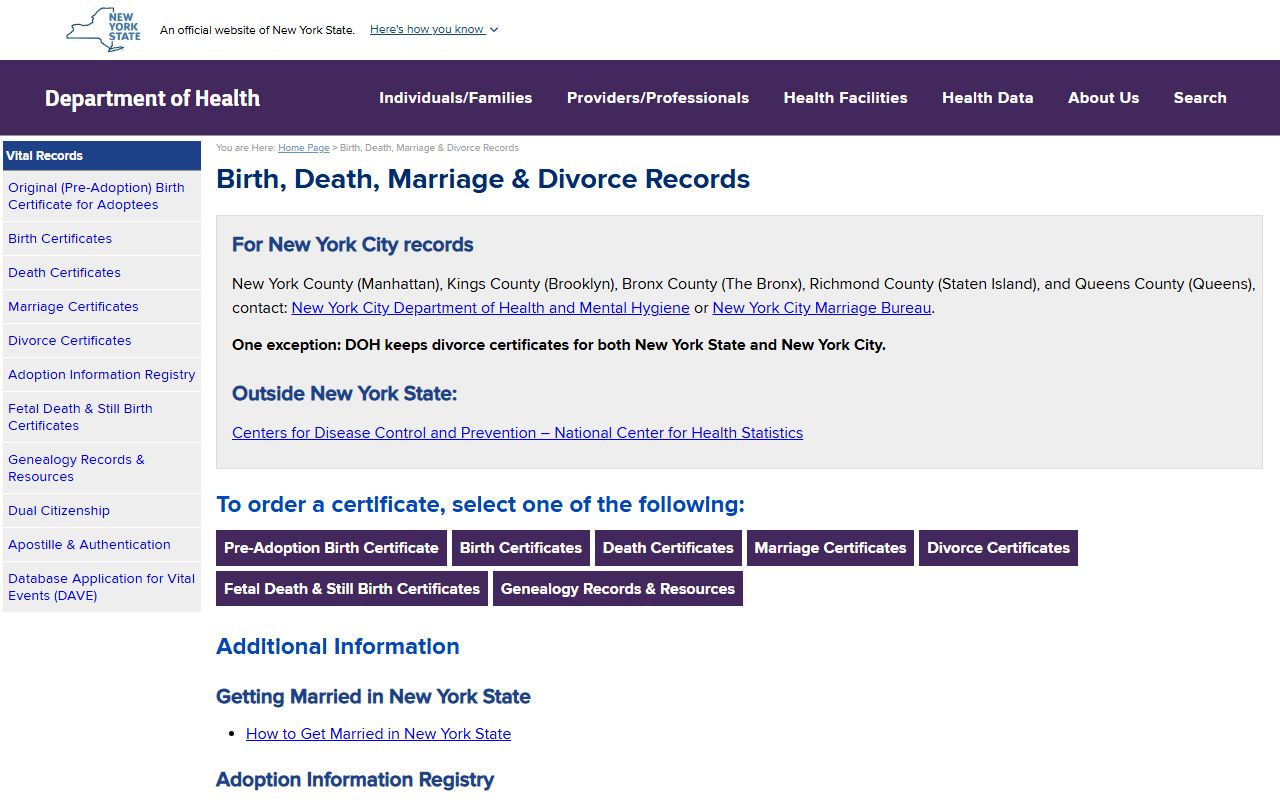
The NYS Department of Health holds death records from the early 1880s for all counties. Write to the Vital Records Section at PO Box 2602, Albany, NY 12220-2602 or call (855) 322-1022. Death indexes become public after 50 years.
Genealogy fees start at $22 for a search covering 1 to 3 years. The cost increases with broader searches, up to $202 for 81 to 90 years. Processing takes 8 months or more. Knowing the exact year of death saves money and may speed things up slightly.
The NYS Archives has free microfiche indexes covering the statewide death index. These are searchable in person at the archives in Albany. The indexes list name, date of death, place of death, and a certificate number. This is the best free starting point for any Niagara County death index search when you do not have exact details.
Death Index Search Tips for Niagara County
The key challenge in Niagara County is identifying the right registrar. With two cities maintaining separate vital records and numerous town clerks, you need to know where the death occurred. Hospital locations matter. A person who lived in the Town of Wheatfield might have died at a hospital in Niagara Falls. Their death record would be in Niagara Falls, not Wheatfield.
Use the statewide death index to narrow things down. The microfiche at the NYS Archives lists the place of death, which tells you exactly which clerk has the record. This step can save you from contacting the wrong office.
Cemetery records can also help. Niagara County has many cemeteries, and local genealogical societies have transcribed some of them. A grave marker can give you a death date and sometimes a place of death, which points you to the right registrar.
Under 10 NYCRR 35.4, New York governs death record access. Vital records are not available through FOIL. Direct-line descendants can request death records regardless of age with proof of their relationship to the deceased.
Niagara County Naturalization Records
While not death records, the Niagara County Clerk holds naturalization records that can support death index research. These records help confirm identities, especially for immigrants who settled in the county during the 1800s and early 1900s. Naturalization papers often include a person's birth date, country of origin, and date of arrival, all of which can help when searching for their death record.
The county also has land records from 1808. Land transactions sometimes note the death of a property owner, which can provide a death date or approximate period to search in the death index.
Ordering Death Certificates in Niagara County
For deaths in Niagara Falls, contact the Niagara Falls City Clerk. For deaths in North Tonawanda, contact the North Tonawanda City Clerk. For deaths in towns, contact the town clerk where the death took place. For Lockport, contact the Lockport City Clerk.
Include the full name of the deceased, date of death, place of death, and your relationship to the deceased. Most clerks accept mail requests. Specify whether you want a certified copy or a genealogy copy. Genealogy copies are for deaths over 50 years old.
For state copies, mail your request to the NYS DOH with a check or money order. The base fee is $22 for a genealogy search covering up to 3 years. Allow 8 months or more for processing.
Nearby Counties
Niagara County borders Erie County to the south, Orleans County to the east, and Lake Ontario to the north. The Niagara River and Canada are to the west. Erie County, which includes Buffalo, uses a similar local registrar system. People in southern Niagara County often used hospitals in Buffalo, so deaths of Niagara County residents may appear in the Erie County death index.