
Search Madison County Death Index
Madison County death index records cover central New York State, where rural communities and small towns dot the landscape between Syracuse and Utica. Formed in 1806 from Chenango County, Madison County is named for President James Madison. The county seat is Wampsville, a small village that serves as the administrative center. Death records here follow the standard New York local registrar system, with town clerks holding original filings from the 1880s onward. Researchers looking for Madison County death index entries will need to identify the specific town where a death occurred or use the statewide indexes maintained by the NYS Archives.
Madison County Death Index Overview
Madison County Death Records Overview
Death records in Madison County are not held at the county level. Town clerks serve as local registrars. Each clerk files death records for events that happen within their town's borders. This is the standard approach across New York State.
The Madison County Clerk in Wampsville handles land records, court filings, and other civil matters. The clerk does not issue death certificates. For death index records, you must go to the town where the death was recorded or to the state.
Madison County includes the towns of Brookfield, Cazenovia, DeRuyter, Eaton, Fenner, Georgetown, Hamilton, Lebanon, Lenox, Lincoln, Madison, Nelson, Oneida (partly), Smithfield, Stockbridge, and Sullivan. The City of Oneida straddles the Madison-Oneida county border. Each jurisdiction has its own clerk for vital records.
Where to Find Death Index Records
The first step is finding out where the death took place. New York files death records in the municipality where the death occurred. A person who lived in Cazenovia but died at a hospital in Syracuse would have their death recorded in Onondaga County, not Madison County.
If you know the town, contact that town's clerk directly. Most clerks accept mail requests. Include the name of the deceased, the date or year range of death, and the place of death. Your contact information and your relationship to the deceased are also needed.
If you do not know the town, use the statewide death index. The NYS Archives has microfiche indexes that are free to search in person. These cover death records from the 1880s forward and list name, date, place, and certificate number for each entry.
State Death Index Resources
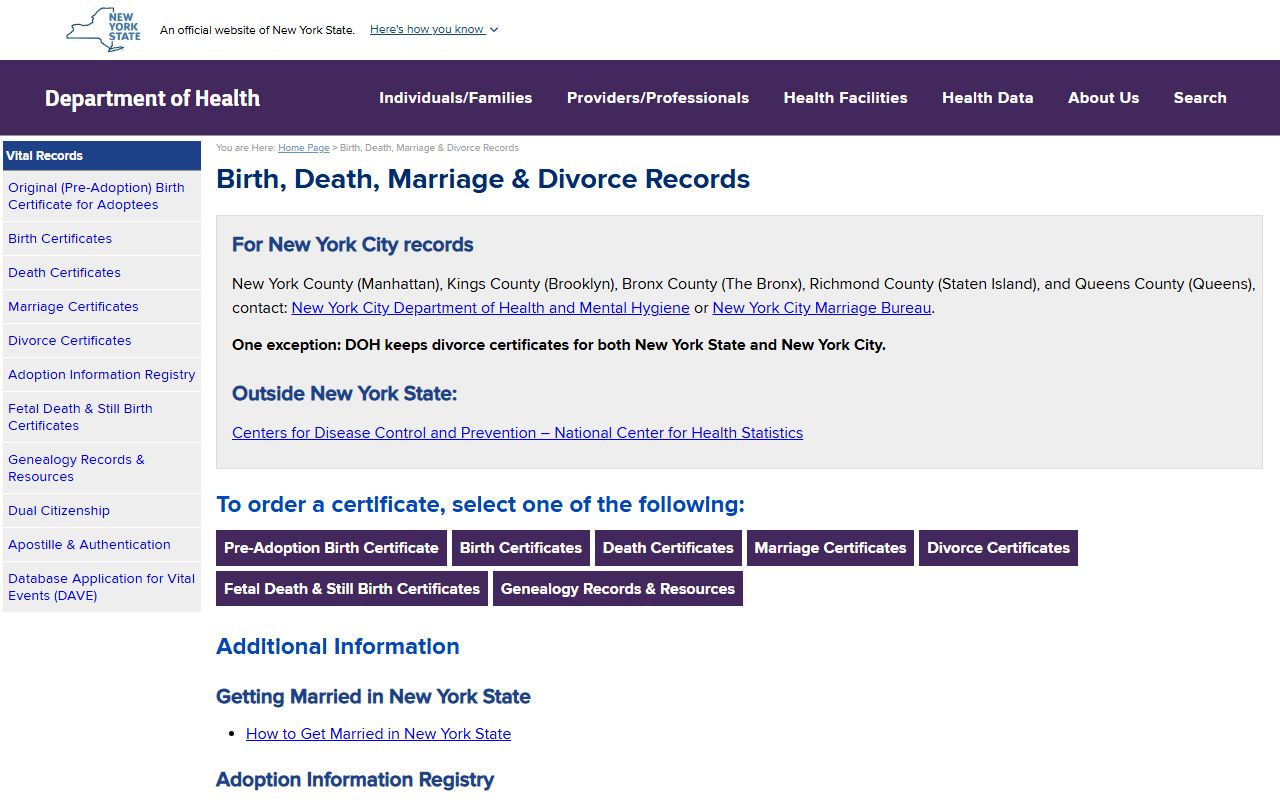
The NYS Department of Health maintains death records from the early 1880s for all counties. Write to the Vital Records Section at PO Box 2602, Albany, NY 12220-2602 or call (855) 322-1022 for information.
Genealogy search fees start at $22 for a 1 to 3 year range. The cost goes up with wider searches, reaching $202 for 81 to 90 years. Processing takes 8 months or more. This wait time is a common frustration but reflects the volume of requests the state handles.
Death indexes become public after 50 years. Records older than 50 years can be requested by anyone for genealogy purposes. For more recent deaths, only authorized persons like next of kin can get copies. Under 10 NYCRR 35.4, the state sets the rules for death record filing and access. Vital records are not available through FOIL requests.
Madison County Genealogy and Death Records
Madison County has a strong genealogical community. The county's history goes back to the early 1800s, and many families have deep roots here. Death records from the late 1800s and early 1900s can include parents' names, birthplace, and cause of death, all useful for building family trees.
The Madison County Historical Society in Oneida maintains collections of local records. These include manuscripts, photographs, and documents that may relate to death index research. Church records are particularly useful in Madison County, where congregations kept detailed registers of deaths and burials.
Cemetery records are another avenue. Madison County has many old cemeteries scattered across its towns. Some have been transcribed by local volunteers and genealogical societies. These transcriptions can confirm death dates when official records are missing or hard to access.
Colgate University in Hamilton has a library with local history resources. While not specifically focused on vital records, the university's archives sometimes hold materials relevant to death index and genealogy research in the area.
Ordering Death Certificates
For local copies, write to the town clerk where the death occurred. Include the full name of the deceased and the date of death. Specify whether you need a certified copy or a genealogy copy. Genealogy copies are for research only and are available for deaths over 50 years old.
For state copies, mail your request to the NYS DOH with a check or money order. The base fee is $22. Allow 8 months for processing. If you have the certificate number from an index search, include that. It speeds things up.
Direct-line descendants can request death records regardless of age. You need proof of your relationship. A birth certificate showing the deceased as a parent, or a series of documents linking you through generations, will work. The state and local registrars both accept this type of request.
Pre-1880 Death Records
Official death registration did not start in New York until around 1880. For deaths before that date in Madison County, you need to rely on other sources. Church records are especially valuable here. Many congregations in central New York kept death and burial registers going back decades before the state required vital records reporting.
Cemetery transcriptions, newspaper death notices, and family Bible records can all provide death dates from the pre-registration period. The Madison County Historical Society may have some of these materials in their collection. Local libraries in the area sometimes hold microfilm or digital copies of early newspapers that contain death notices and obituaries.
Nearby Counties
Madison County borders Oneida County to the north, Otsego County to the east, Chenango County to the southeast, Cortland County to the south, and Onondaga County to the west. Death records in these counties use the same local registrar system. People who lived near the county line may have died in a neighboring county, so checking adjacent death indexes is sometimes necessary.